Nomad Star Travel, LLC offers pre-planned group excursions with scheduled outdoor immersion activities, interpersonal learning and development opportunities, and guided individual reflection. Challenge yourself to meet new people in a supportive and growth-oriented environment! We also offer private journey planning options for individuals who prefer a solo quest.
The connection between personal growth and travel is not a new concept. Many faith and initiation practices involve the physical act of separating the self from routine to embark on a journey into the unknown. It is believed that through the process of giving of the self and confronting uncertainty while moving along a literal or metaphorical sacred path, the traveler will arrive at a destination of deeper understanding with their spiritual purpose, transformed into a person who will successfully and gracefully meet the challenges of their next phase of life. This internal or external, literal or metaphorical journey, represents initiation from one cycle into another. It forces us to set intentions and navigate the unknown, while also presenting us with emotional obstacles we must gracefully overcome.
Through intentional and intuitive planning, adventure, and reflection we connect with a source of strength that propels us toward a more meaningful identification with a web of life that is older than us, more intelligent than us, and more resilient than us. We learn to transform our mindset to recognize success, to accept social responsibility, and to act through faith. As we journey into a world that is currently unknown to us, we confront the uncertainty within ourselves and begin to overcome our emotional and psychological barriers, for continued alignment with success, growth, and transformation.
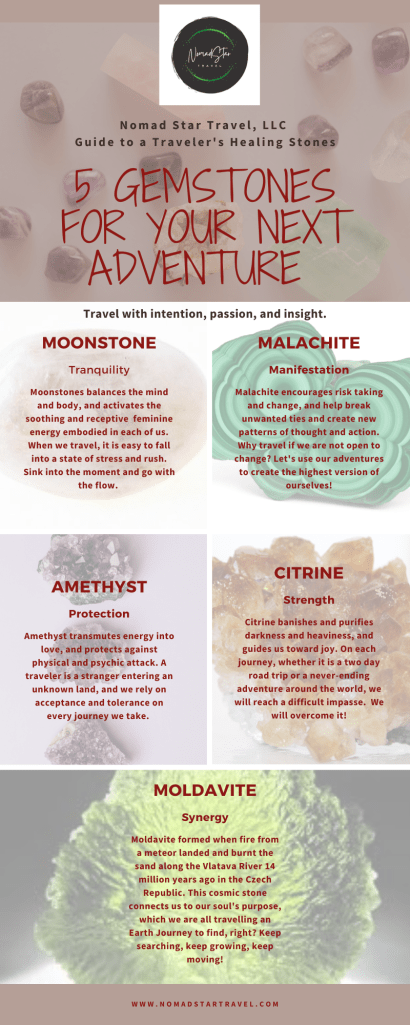
When we charge stones, we set powerful intentions for what we will seek and explore next along our Earth journey. Whether it is the stones themselves that create this reality, or simply that they are conscious reminders of what we want to find, they serve as guides directing along our path. These are five powerful stones to carry with us on our journey, and how others before us have carried them.
Anela and I had already made plans through the Couchsurfing website to meet up before I even arrived in Sarajevo. When she met me at the bus station to show me to my guest house, we confirmed that the next day, we would hike to Skakavac Falls. At 321 feet, it is Europe’s second highest waterfall, falling behind only Austria’s Krimml Waterfalls.
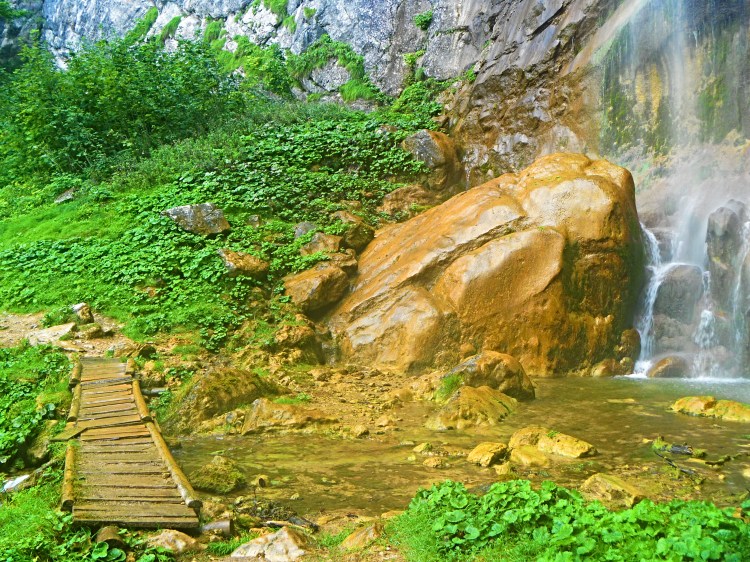
Water flows down 321 feet at Skakavac Falls outside of Sarajevo, Europe’s second highest waterfall.
Skakavac translates into “grasshopper” in English. It is named from its stream of origin, which follows the peak of Bukovik and then flows into the Perak creek. The start of the trail is located about seven miles from Sarajevo, and then a five mile loop trail will guide you through wildflowers, grassland, and forest to the waterfall. Some people describe the trail as “rugged,” but I would call is easy-moderate. It is definitely not accessible for people with mobility devices, and the steep spiral staircases could present difficulties for young children or the elderly, but a reasonably healthy adult can comfortably finish the trek in a few hours.
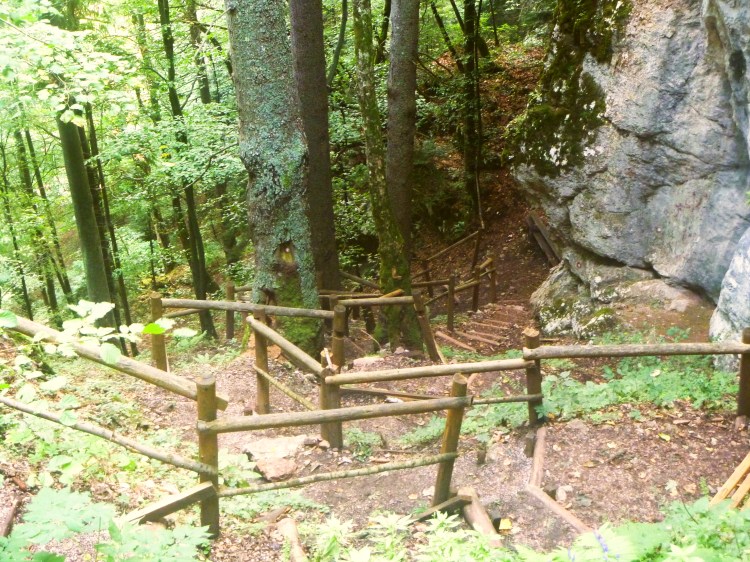
A winding wooden staircase leads us into the forest and to the base of the falls.
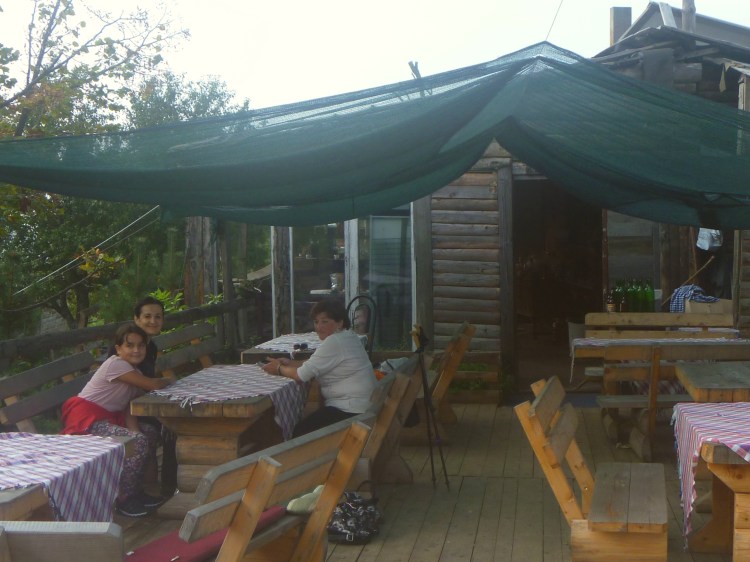
Anela and I met up with her friend Helena, and her daughter Dragona. The four of us drove together in Helena’s Ford Fiesta to the trail head (Helena and I have the same car!) and stopped at a rustic cafe called Kafana Prohama to embolden our spirits first. Alena and Helena wanted me to sample raki, a sweet, herbal aperitif popular in Serbia and Bosnia. The cafe owner was excited to share from his personal bottle, a batch distilled with pine needles. I can’t say I loved it, and during my travels through the Balkans, I was able to limit my consumption of raki to twice. The second time was while a guest with a local family in Nis, Serbia.
Dragona and Helena (L), Anela (R) relax at the Kafana Prohama after our hike.
Interestingly and perhaps synchronistically, both Anela and Helena had been to the United States each once before. Of all the 3.8 million square miles that is America, they had both separately visited southwestern Ohio. Anela has friends in the northern Kentucky/Cincinnati area where I am currently staying, and Helena had gone to Dayton to participate in the 1995 Dayton Accords, which ended the Bosnian War. I felt a camaraderie with these two women and with Helena’s shy daughter, and the experience reminded me of the importance of staying open to new social connections while traveling. As an INFP, it is much easier for me to stay independent and follow my own flow in life, but forming connections with other positively-aligned humans will reaffirm my energetic path.
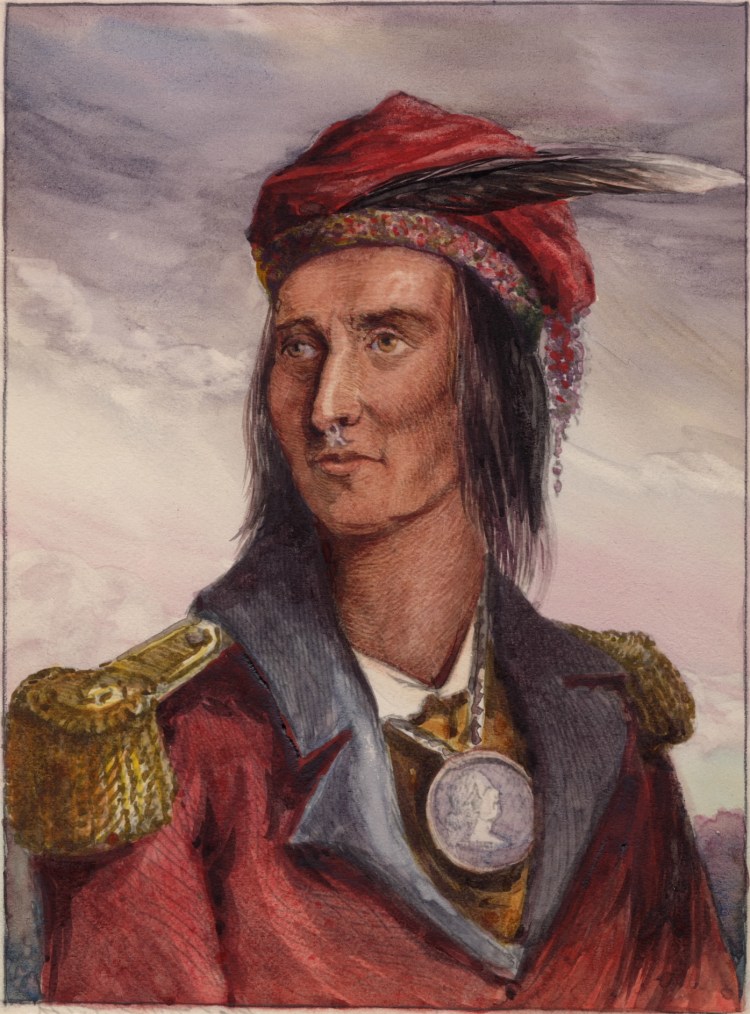
The land of Ohio has a powerful relationship to the Indigenous People who lived in this area for many thousands of years before the European people arrived. The word “Ohio” is itself derived from a word in the Iroquois language for “good river.” That is fitting as Ohio is home to several networks of rivers and tributaries. Also, Tecumseh, the leader of the Native American Confederacy, was born in Ohio. Tecumseh fought to the death to unite the Indigenous People of what is now Ohio, Indiana, and Michigan, to secure a hunting ground and a territory, protected against European colonization.
Portrait of Tecumseh, Shawnee warrior who resisted British imperialism into what is now the Ohio River Valley.
The British were allies with the Native American Confederacy, and during the Treaty of Ghent, the British implored the US Government to return that land to the Indigenous People. However, Ohio was granted statehood in 1803, and then after Tecumseh died in battle in 1813, Indiana followed in 1816, and Michigan in 1837. What remains of the long-standing Councils and the multitude of tribal communities that inhabited the land are relics in museums and several sacred burial grounds.
Recently, I explored three such burial grounds, called “mounds” or “earthworks.” The earthworks are places of ceremony, social gathering, worship, and burial. Although Ohio has many numerous earthwork sites, those I visited are all located in the southern end of the state, between Cincinnati and Athens.
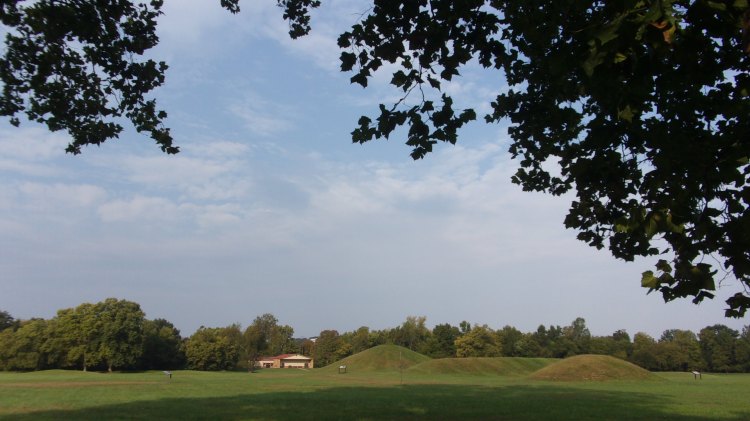
The Mound City Group is one of six Hopewell National Historical Sites. This 13-acre space is enclosed with a 4-foot earth wall, and is home to 23 mounds. The largest mound is 17 and a half feet high, and 90 feet in diameter.
Hopewell Earthworks located 12 miles west of Chilicothe, OH.
The mounds are what remains from the Hopewell culture, who is thought to have lived in the area from 1-400 AD. Historians and archaeologists speculate that each mound used to house a ceremonial building, based on clues such as artifacts, clays, and ashes. After the building was purposefully dismantled, the mound was constructed.
History almost lost this site. After land pressures in the mid-late 19th century, it was plowed over for farming. Fortunately, two historians had mapped the original site, and it was successfully reconstructed in the 1920s.
Seip Earthworks is another one of the six Hopewell National Historical Sites. It is 120 acres of two circles and a 27-square acre astronomical alignment. Sadly, many of the geometric earthworks were destroyed during colonial expansion. Tim Anderson Jr’s drone footage from 2016 is a birds-eye view of what has been preserved, and is now part of the National Park Service. My visit was fairly short, but I did take a peaceful moment to prepare morning coffee over my propane backpacking stove and to bask in the fresh autumn sunlight.
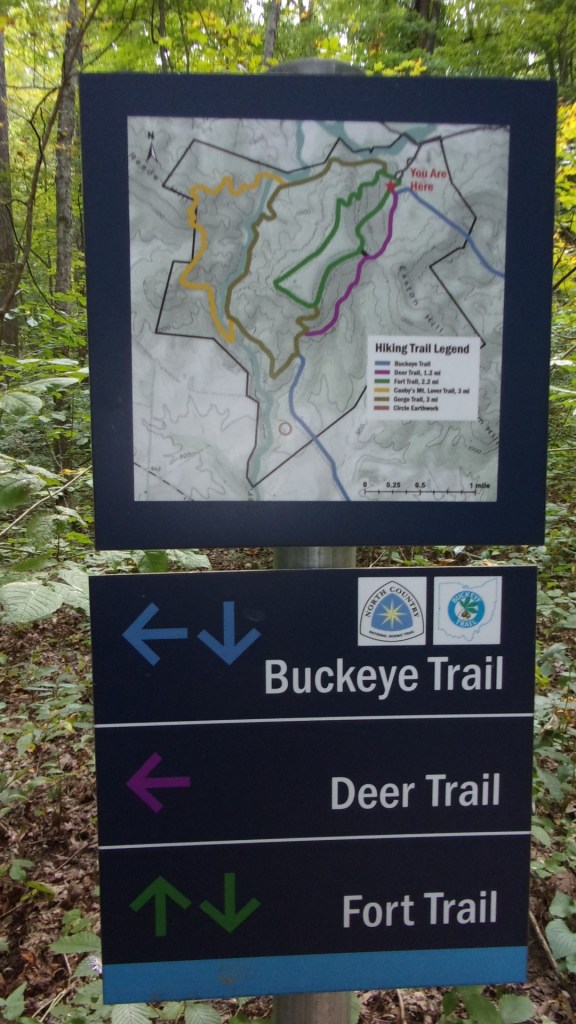
I almost bypassed this site, in favor of continuing on to my final evening of camping, but it ended up being my favorite, and most adventurous, afternoon. This site apparently has two earthworks, one at the top of Fort Hill with 33 gateways and 1.5 mile circumference; and a second, more difficult to locate, Circle Earthwork. I opted to trek along the Buckeye Trail to find the less accessible mound.
Trail map at Fort Hill Earthworks.
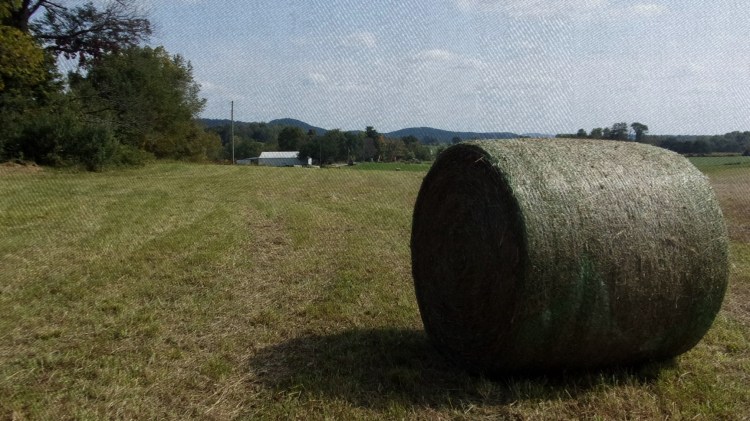
After perhaps two miles along a steep and uneven path, I was on a narrow trail overgrown with spider webs and vegetation. I waved a stick in front of me with each step to avoid spiders in my hair. Eventually, the trail abruptly ended in a field. A farmer was baling hay in the late afternoon heat, and I wondered if I had taken a wrong turn. I stumbled a bit over the uneven soil, and then finally noticed a slightly elevated area of earth to my right. I had found it, the Circle Earthwork. I felt satisfied and accomplished.
Uneventful yet still accomplished at the end of the trail.
We can’t change the course that history followed, but we can choose which version of history we honor: the brutish violence of colonization, or the powerful energy of a movement toward reclamation that is very much alive. We can choose our heroes, and how we name the victors.
Stillness and silence nurtures a connection with transiency that is a familiar feeling for those among us who travel. We are always shifting and adjusting to fill the spaces around and within us. Through centering, I feel the space within me unfold into an acceptance of impermanence and walking meditations in a labyrinth is one way to connect to this timeless moment.
Labyrinths have been around for over four thousand years, and labyrinthine symbols date back to the Neolithic age. Through shifting the mental constructs of linear time and space having origins only between two separate points, they aid in the traveler’s discovery of their true Self. They guide the seeker into a compression of time and space.
On one particularly bleak Sunday, I decided to venture into that sacred space of my center. Using the World-Wide Labyrinth Locator, I filtered the search function to find ten labyrinths within a 10 mile radius of my zip code. The World Labyrinth Locator is an online project of The Labyrinth Society. Launched in 2004, it is a database that contains over 6050 labyrinths across 85 countries. These are my three favorites in the city of Cincinnati.
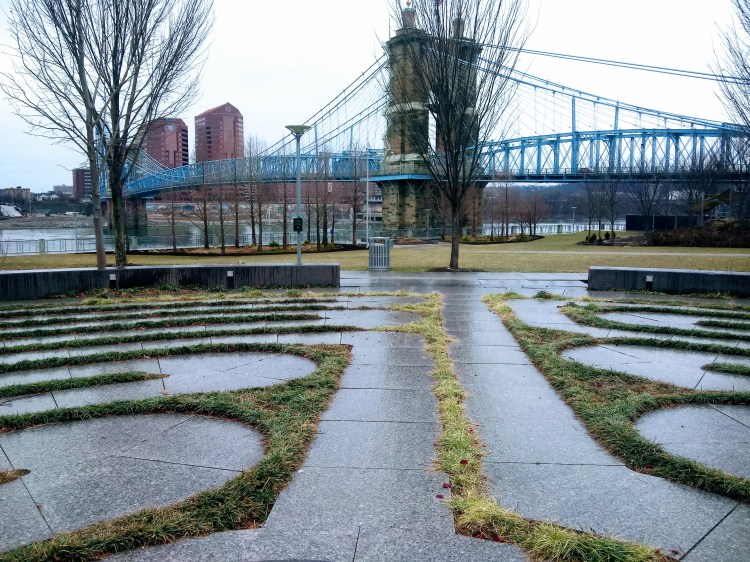
The Smale Riverfront Park has a gorgeous labyrinth located between the Roebling Bridge and the Black Brigade of Cincinnati Monument. The total distance from entrance to center and back is half a mile. When I began the journey, I was the only one walking. Within ten minutes, a young girl on a tricycle who was on the Ohio River Trail with her father saw me and wanted to explore as well. Although they didn’t seem to understand the purpose, they at least opened their perspective enough to wander into a circle that perhaps they had never before noticed.
Smale Riverfront Park labyrinth.
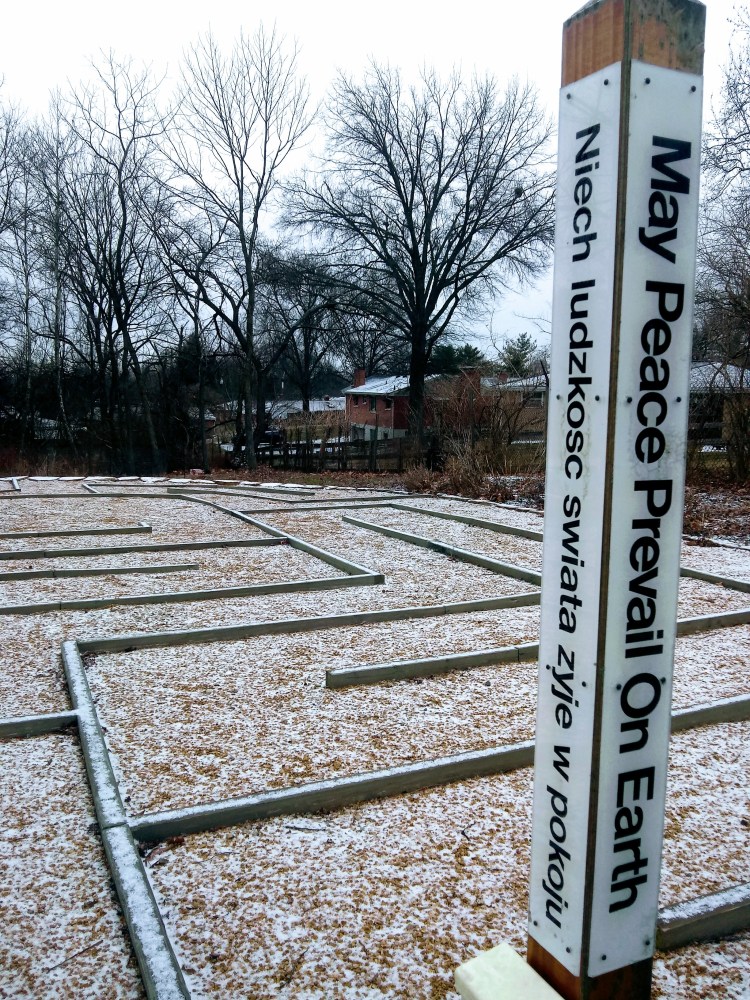
I traveled to a new area of the city to walk this labyrinth, located behind the Unity of Garden Park church. Designed to represent the mythic Phoenix who rises from its ashes to fly away, symbolizing healing and transformation, I felt an alignment of time and space while weaving through the pathways and visualized a peaceful transition from the chaos of 2020, and into a more stable 2021. The words, “May Peace Prevail on Earth,” mark the beginning and end, printed on a post in four languages.
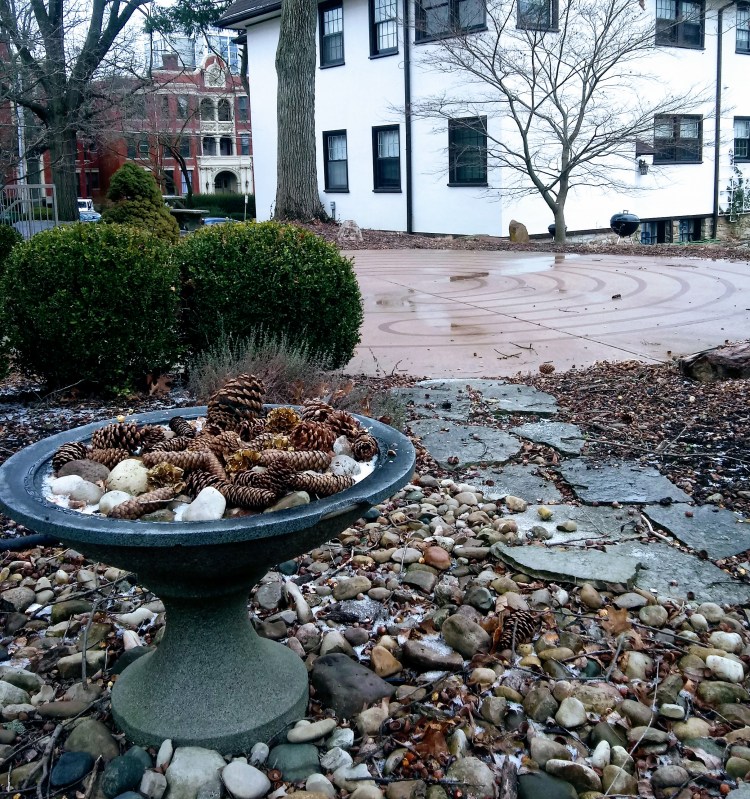
Labyrinth at the Unity of Garden Park Church.
Located in the beautiful and historic Cincinnati neighborhood of Walnut Hills is the New Thought Unity Center with it’s outdoor meditation garden and labyrinth. The Cincinnati Magazine from October 15, 2020, gave the labyrinth a bit of publicity. In this online article, Larry Watson, the center’s head prayer chaplain explains the installation’s purpose of creating and releasing an intention, whether “a concern, belief, sadness, emotion, pain, anger, shame.” The process of following the path gives space to reflect on the intention before releasing it. Watson explains that, “working into the center, through the labyrinth, gives us time to be comfortable letting it go.”
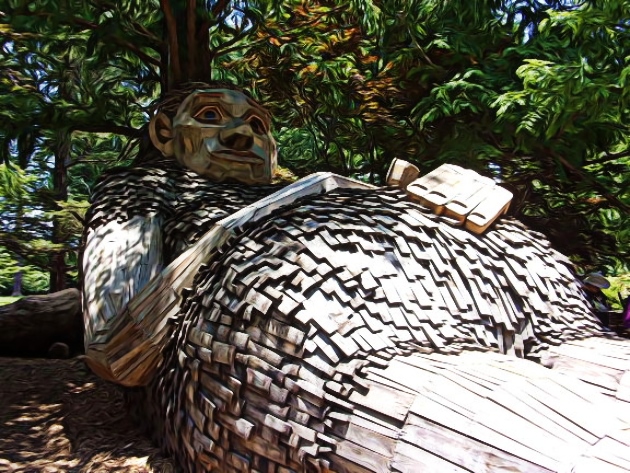
Mama Loumari at the Bernheim Arboretum and Research Forest near Lousiville, KY. 2019.
Forest bathing is the hot new breed of nature therapy to hit the US. It’s not as risque as it sounds; chances are many of us forest bath on a regular basis. Forest bathing is a Japanese practice called shinrin-yoku. Shinrin-yoku emerged in the 1980s as a psychological and physical exercise to counter the negative social effects of the emerging electronic technology, and also to reconnect people to the island’s lush and ancient forests. A conscious, intentional walk through a grove of trees, observing the scent of the soil and the air moving over the skin is forest bathing. It is mindfully walking through the woods.
Professor Yoshifumi Miyazaki of Japan’s Chiba University was the first research pioneer to explore the science behind the practice, and in 2016 he discovered that “even short periods of viewing or walking in natural places results in … lower blood pressure, decreased heart rate, reduced cortisol production, balance of activity and hemoglobin in the prefrontal cortex, improved blood glucose levels, higher immune function, and overall physiological relaxation,” (qtd.in Haupt 82). Our bodies and brains evolved to exist in nature, and scientists like Miyazaki believe that our modern lives have propelled us into a chronic state of stress; that heightened state is measurably more calm after only 15 minutes in a forest (Haupt 82-83).
While researching forest bathing to write this piece, I kinda laughed-out-loud when National Geographic suggested traveling to Kenya, Costa Rica, and New Zealand. Yes, that sounds fabulous, but until we have that cash on hand, let’s explore forests that are more accessible. All trees are created equally. I ventured across the Ohio River into the exotic land of Kentucky to share my forest baths with Danish giants.
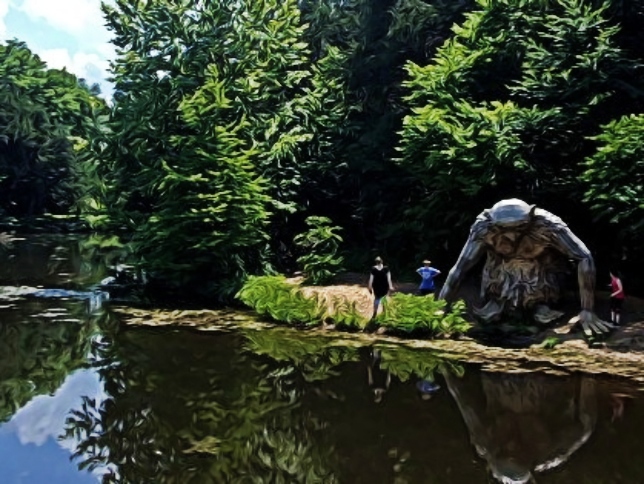
Forest Giant Little Nis gazes upon his reflection. 2019.
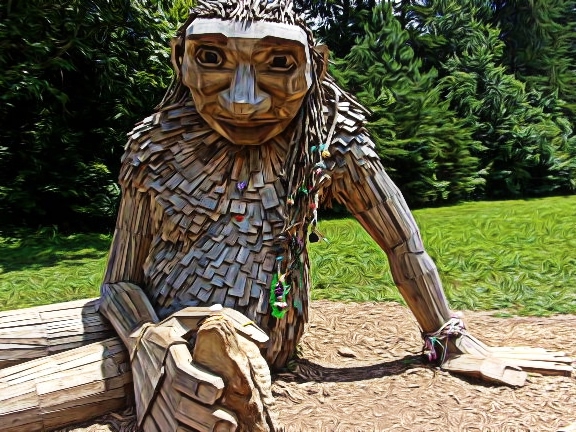
The Bernheim Arboretum and Research Forest is about 45 minutes south of Louisville, Kentucky. In 2019, they celebrated their 90th birthday, and invited Danish giants to join them for a three year party. The family of Giants, named Mama Loumari, Little Nis, and Little Elena, are lounging among trees, gazing into the water, and contemplating life in the solitude of a meadow, on a two-mile loop trail through old growth.
Where is the father, people might ask, noticing Mama Loumari’s belly, fertile with life. As the Danish artist Thomas Dambo explains in the fairy tale that tells the Giants’ story, “The Great Story of the Little People and the Giant Trolls: While the Weather Got Better,” the father, named Isaac, felt lonely on the mountain. He built his family a circle of love, where Mama Loumari rests, and then left to wander the prairie until the weather got better on the mountain.
Forest Giant Little Elina contemplates the nature of a stone. 2019.
The Bernheim Arboretum and Research Forest is open during the pandemic, and advanced reservations are required. Although it is free to visit, they do request a donation of $10 for each vehicle that enters. None of the facilities are open, so plan accordingly. As always, forest bathing is free, and the Giants are happy to share their trees.
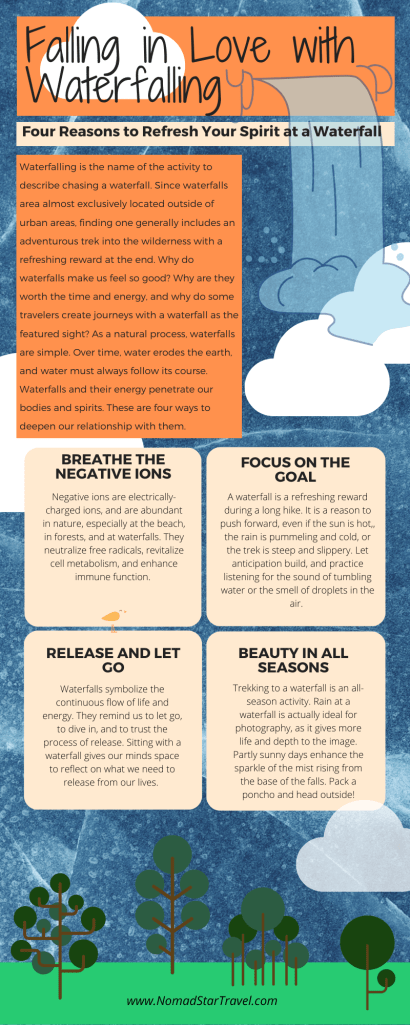
Turkish playwright and novelist Mehmet Murat Ildan can hear the waterfalls speak. He shares his knowledge with us, describing how, “there is a hidden message in every waterfall. It says, if you are flexible falling will not hurt you.” Waterfalls symbolize the continuous flow of life and energy, and fill the air with beneficial negative ions. What do you need to do to add some waterfall to your life this Spring?
 Following the Nomad Star