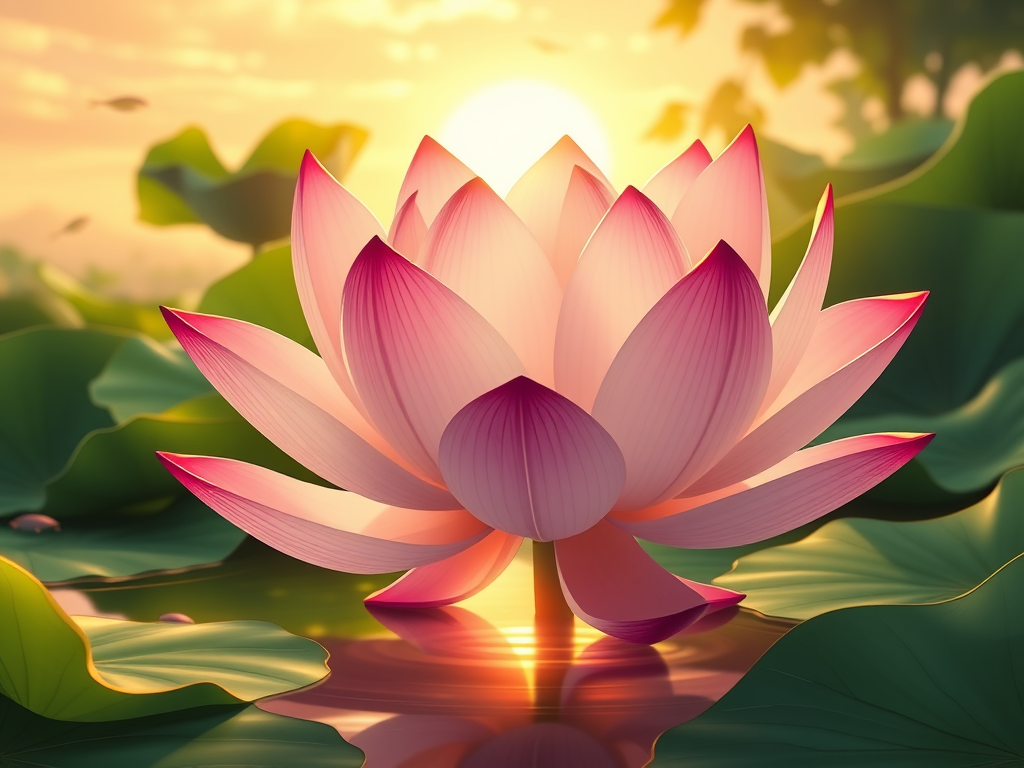
In nature, lotus flowers are heliotropic. This means they respond to the position of the sun. Its petals open each morning, providing shade for aquatic life and reducing water evaporation, and in the evening as dusk settles, it contracts and closes, emerging back into the muddy waters from which it grows. As a contributor to its aquatic ecosystem, the lotus flower is an attractive pollinator, and it absorbs extra nitrogen and phosphorus from the water and sediment.
The lotus flower is also an important spiritual teacher. Symbolically, it represents the resilience of awakening, of shifting from one state of being into another.
A proverb from the Buddhist tradition reminds us that, “like the lotus flower, we too have the ability to rise from the mud, bloom out of the darkness, and radiate into the world.” Follow the light, and respond to the position of love.
This can be difficult at times. Maybe the mud is really deep, the night is too long, and you are not sure your beautiful petals can feed all the insects buzzing around you in search of food. It is important in those moments to find stillness that allows the mind to focus on creating a sense of resilience. Sometimes, awakening is an act of conscious intention.
One practice to create conscious intention is to use a mudra. Mudras are hand gestures or “sealing postures” to “stimulate and redirect the flow of energy” that travels through our electrical or subtle body. This subtle body is an aspect of our Mind, Mind with a capital “M” because it is deeper and more powerful in our lives than simply our intellect or cognitive processes. When our Minds with a capital M are connected to how our energy is flowing through our subtle body, we are more active and conscious in how we are showing up in the world. These “sealing postures” give space for heightened awareness.
The Lotus of the Heart is a mudra from the 5000 year old Vedic Indian practice of Yoga that encourages a moment of stillness to create hopeful awakening. It activates a flow of energy into the area of the heart, while simulating the open petals of the lotus flower. It is not the hand gesture itself that shifts the energy in the subtle body; instead, it is the Mind and its focus on receptivity, spaciousness, and surrender that transforms the flow. When the Mind is open to observing inner experiences without judgement, the IDEA of our own challenges in life are transformed. We are more open, and we see and feel opportunities that otherwise may not have been visible to us. Our hearts, as literal organs, have their own “mini brains,” and the Lotus of the Heart mudra is one way to settle agitated, frustrated, and desperate neuron activity.
To practice the Lotus of the Heart:
- Begin in a comfortable seated position, either cross legged or with both feet planted firmly on the floor. Straighten the spine.
- Press your palms together in front of your breast bone. Imagine your elbows pulled away from your body in the opposite direction. Lift your chin. Imagine a string pulling the top of your head to the sky.
- Press the inside edges of your two pinkie fingers, the side edges of your thumb, and the base of your two wrists together. Keeping these three points of contact, slowly and with awareness, begin to spread apart your inner three fingers. Curve your palm slightly to form a cup. Your three inner fingers will be extended and straight, pointing slightly outward toward the sky, while your pinkies, thumbs, and wrists are pressed together.
- With your hands and fingers resembling a lotus flower, gaze into the cup of your palms and bring your awareness to your breath. This is the most important step. Slow your brain, and focus its thoughts on awakening resilience.
If you are having a difficult time focusing, maybe it will be helpful to use your inner voice to say something like, “my heart is awakening to the love that surrounds me,” or “I am a lotus flower that follows the light of love.” Maybe you want to close your eyes and imagine your favorite color glowing in the space of your lotus-like hands and heart.
“Be like the Lotus: trust in the light, grow in the dirt, believe in new beginnings.”
Yogic proverb
The impact of this practice is to inspire feelings of receptivity, to allow your brain to actually believe that it is in a space of openness, expansion, and awakening. After all, in the heart’s still waters, the lotus of awareness opens its petals to the sun.
Although we cannot change the mud and have very limited control over our external environments, we do have the ability to adjust how we flow through it all. The lotus flower, as a symbol of resilience and awakening, can serve as a metaphor from nature to guide our Minds toward a peaceful and abundant life. Even from within the deepest mud, we are capable of blooming.
References
Light of Yoga. B.K.S Iyengar. Schoken Books. 1979.
Yoga and Ayurveda: Self-Healing and Self-Realization. David Frawley. Lotus Press. 1999.
The Yoga Sutras of Patanjali. Translation and commentary by Sri Swami Satchidananda. Integral Yoga Publications, Ninth Printing. 2020.
The Art and Science of Raja Yoga. Swami Kriyananda. Crystal Clarity Publishers. 2002.
 Following the Nomad Star