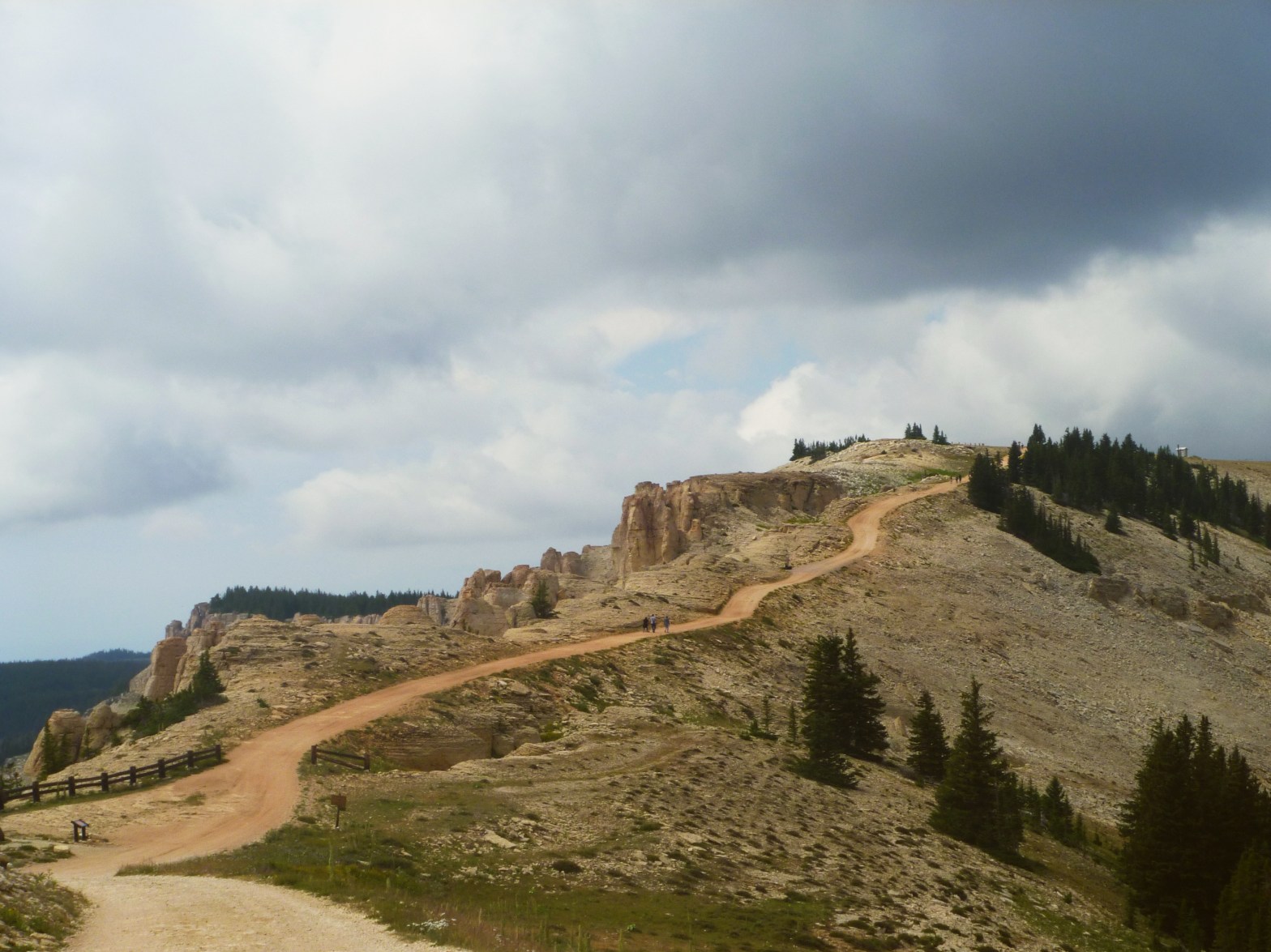
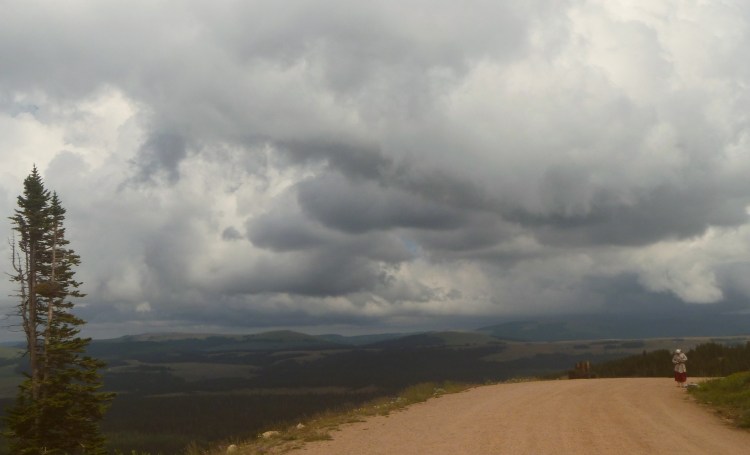
On the 28th day of July, at the full moon in Aquarius, I drove into the mountains of the Bighorn National Forest, searching for the medicine wheel. Located at around 10,000 feet in elevation, the medicine wheel and the Forest Service road leading to the Medicine Mountain Trail, is obscured with snow for most of the year. Even on this late day in the summer, heavy clouds threatened overhead, and a chilly wind dropped the temperature down to 44 degrees.
It is significant that I searched for this sacred site on the 28th day of a month, in respect to the power of the number 28. The medicine wheel has 28 spokes, as does the lunar cycle. According to Toltec shaman Don Jose Ruiz in his book The Medicine Bag: Shamanic Rituals & Ceremonies for Personal Transformation, the medicine wheel is and “has always been an integral part of spiritual life. It contains the cardinal directions of north, south, east, and west … In this way, the medicine wheel is a physical object represented in symbolic artwork, and the image of the wheel is built into landmarks at sacred locations, which are often meeting places for communal ceremonies and rites.” In Western thought, the 28th day of July marks the successive rise of the star Rigel first, and then Sirius 28 days later. Furthermore, the full moon in Aquarius represents a connection to the future, non-attachment, and visionary ideas. I was ready to connect to a spirit map in search of my inner cardinal directions, my own north.
With my belongings loaded into my fuel-efficient Ford Fiesta, I had left my days of basking in the Nor Cal sun on the banks of the free-flowing mountain rivers behind me, and my inner-eyes sought only for how a new vision and future could unfold. I searched for the medicine wheel to walk its spokes and in those movements, to align my personal energetic life power with the intentions and inspirations that would blaze my path forward from here.
Although I had written directions to the trail on a page of my journal and had lodged the torn sheet in the console of my car between several CDs and my bottle of water, the trail head proved difficult to find. I continued to gain elevation while my tiny car protested the steady climb. I almost turned around, concerned that perhaps I had passed it, but felt a pull to keep going. Intuitively, I knew I was on the correct road and that what I searched for was still up ahead if I kept driving.
Nearly 50 miles from the turn onto Wyoming’s Highway 14A, I finally found the trail head. From this point, it was a 1.5 mile hike to the wheel. A Forest Service ranger gave a quick warning to bundle into a sweater, to stay on the trail that protects the fragile tundra vegetation from being trampled, and to respect the cultural artifacts and sacred objects that surround the wheel. The hike up the mountain took about half an hour. I shared the trail with very few people, and it was pretty much only myself along with a handful of indigenous people who protect the wheel as their heritage.
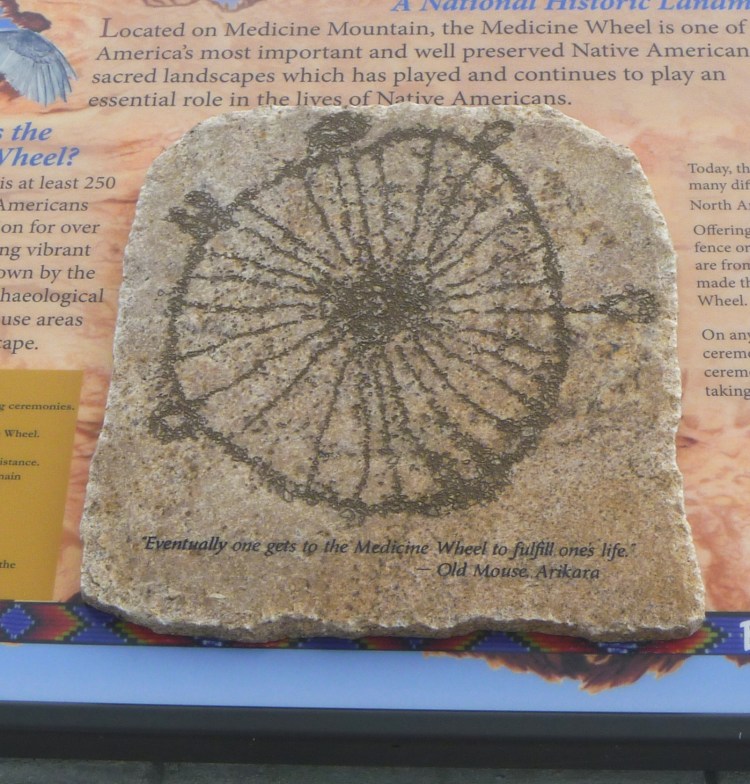
At the base of the wheel, a stone depicts a quotation from Old Mouse, a member of the Arikara people, stating that, “eventually one gets to the medicine wheel to fulfill one’s life.” Here I was, at the medicine wheel, pursuing the question of where my life would go from here; the answer, I knew, was waiting quietly for me to find it. It is in the process of the movement of the body, and in the rhythm of the breath, that those inner secrets are set ajar and unearthed from their hidden places to reveal themselves.
As I hiked back to my car, I passed another woman hiking alone. I had seen her earlier. With her bright red ankle length skirt and a scarf over her head, she stood out against the others of us walking in our jeans and sweaters. She also carried a hand woven basket, and at closer glance, I noticed that inside was a jar of water and a loaf of bread wrapped in cloth. She stopped me on the path and asked that I take her picture. Assertively, she directed me through the location, frame, angle, lighting, and even the theme. “Little person, big world,” she said with a Russian accent. Through a quick dialogue, I learned that she lived in Ranchester, Wyoming, but was from Russia. Ranchester is a village between the remote boundary of the Bighorn National Forest and Sheridan, Wyoming. I wondered why she had come from a remote Russian village to a remote American village? Perhaps, like myself, she had hiked up Medicine Mountain to find herself at the center of four cardinal directions.
 Following the Nomad Star