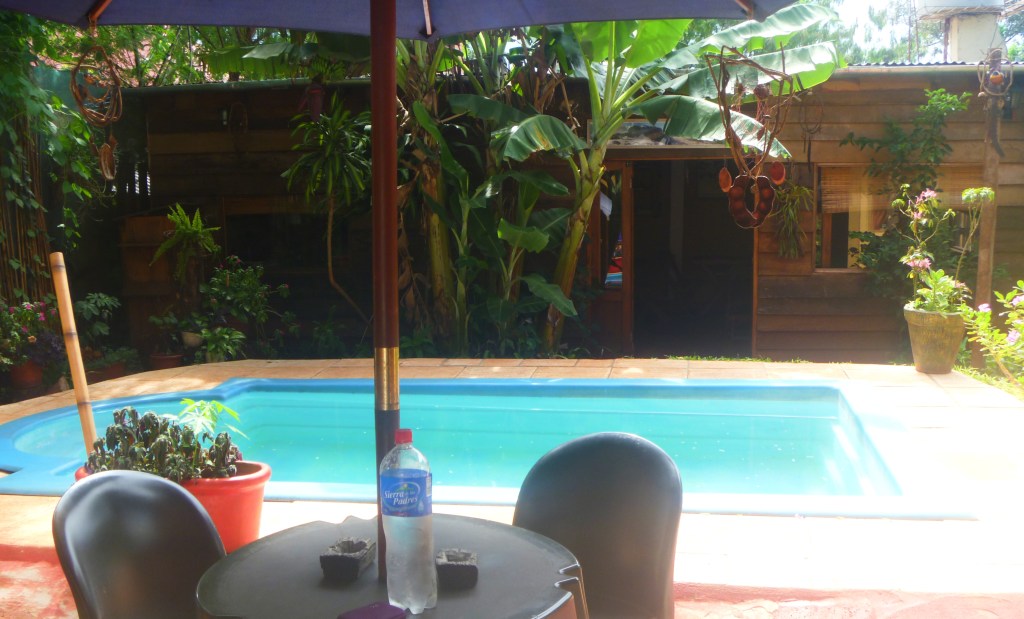
A blast of chilly air massaged my face, damp with perspiration, as I pushed open the door to a four bed bunk room at the hostel. I was in Puerto Iguazu, Argentina, a small border town on the confluence of the Parana and Iguazu rivers. The late February jungle air hung dense, and I had practically swum through the unpaved streets of the town center. It had been a twenty hour ride on a crowded bus from Buenos Aires, and I was in dirty clothes, the soles of my feet blackened from grime, my stomach aching with hunger. My traveling companion was equally ragged in torn cargo shorts and a face many months unshaven; he had begun to knot the longest tips of his beard into a trio of braids, secured with beads at the ends. Puerto Iguazu was the final remote destination on our journey, and from this point we would return overland to Bogota, 4213 miles to the north.
After a brief nap, we used our Steripen to sanitize water, and our hunger then became our primary need. We wandered the plaza, browsing the usual tourist shops selling braided bracelets, freezer magnets, and snow globes with Caucasian-featured figurines holding surfboards. As the gateway town to Iguazu Falls National Park, Puerto Iguazu has developed most of its economic infrastructure around tourism.
After a modest meal of steak and fried yucca root, I followed a trail away from the street cafes and passed modern hotels with valet parking and airport shuttles, to the confluence where the muddy water of the two rivers swirled into ripples and eddies. I was in the Triple Frontier. From this point, I saw three nations: Argentina where I stood, Paraguay across the water on the left bank, and Brazil to the right. VISA requirements prevented me from crossing the borders; the invisible line had been drawn. I had ventured to the farthest edge of my journey.
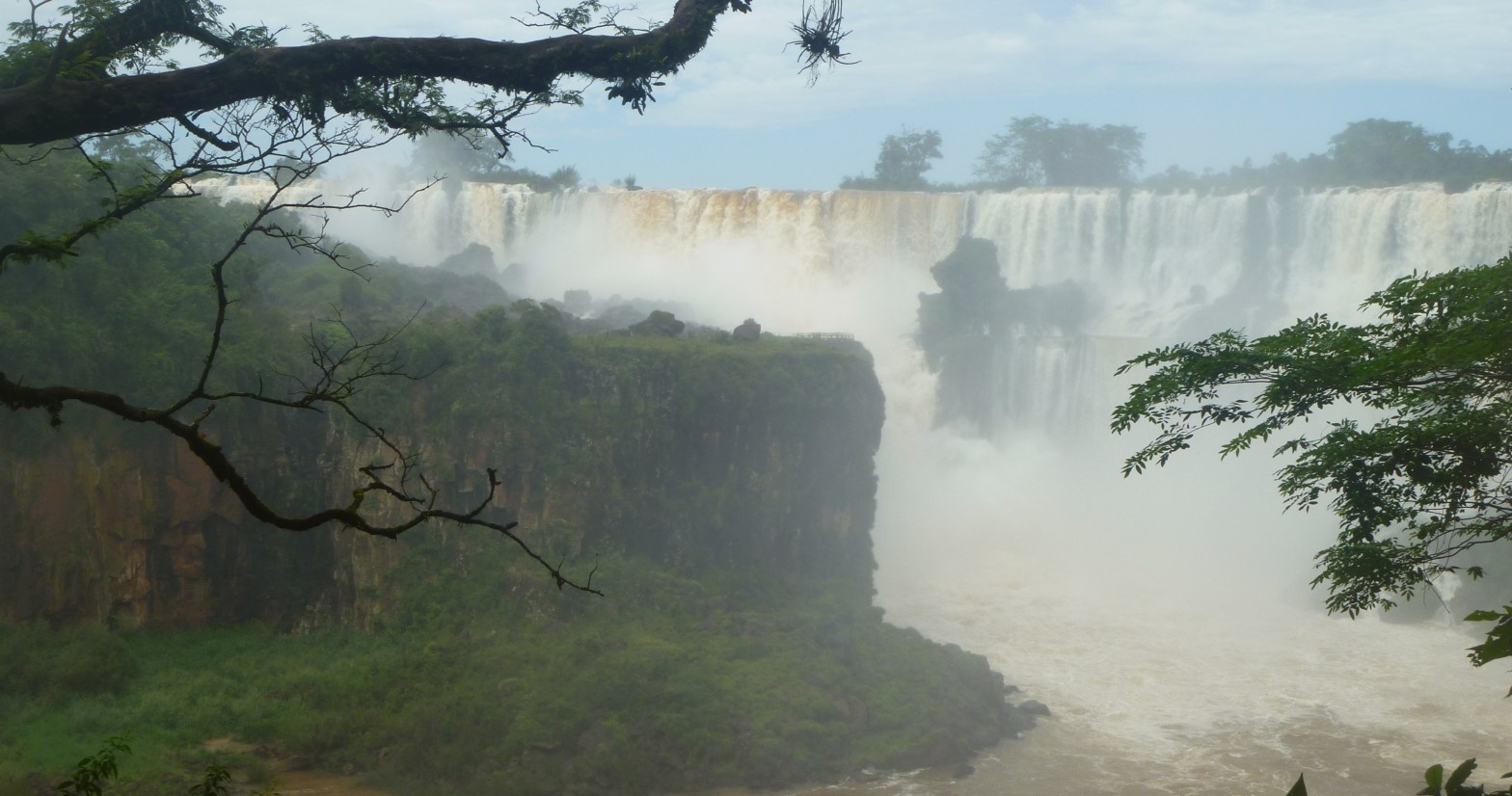
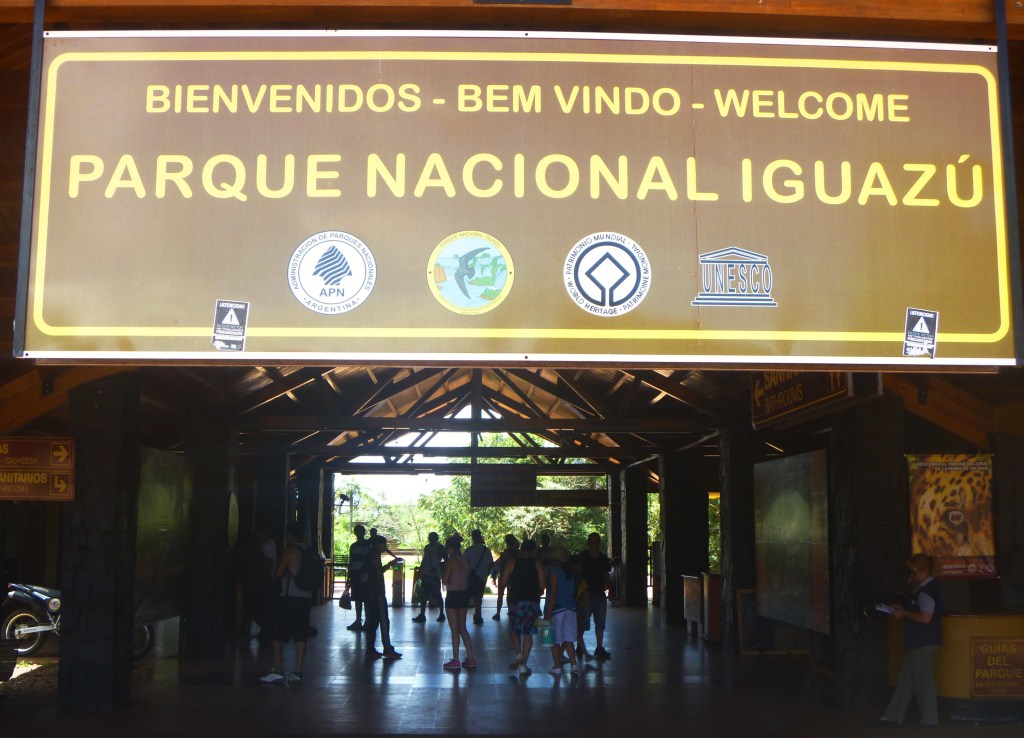
We were there to see Iguazu Falls, an UNESCO World Heritage Site and one of the Seven Wonders of the Natural World. “Iguazu” means “many waters” in the local indigenous language of Tupi-Guarani. True to its name, Iguazu Falls is a collection of 275 individual falls that roll through the heart of the Paranaense Rainforest, making it the largest waterfall system on Earth. The most monumental falls is the Devil’s Throat Falls, where the water tumbles deafeningly into a canyon 80 meters deep.
Waterfalls produce an abundance of what are called “negative ions.” Negative ions are healthy for our bodies, contrary to what it might seem with the use of the word “negative.” Ions have an electrical charge that is either positive or negative. Positively charged ions have lost one or more electrons, while negatively charged ions are oxygen atoms with a large number of negatively charged electrons. These two types of ions are fundamentally different in their sub-atomic structure. Negatively charged ions can be found in natural areas, such as on beaches, near waterfalls, and in the forest after a lightning storm. They increase a sense of calm and well-being.
Waterfalls are also spiritually symbolic. They represent the process of release, of letting go; they are the continuous flow of life and energy reminding us that no moment in time is the same as the one before it. Each breath, each heartbeat, each blink is a space of awakening into a new experience that invites vitality, awareness, and strength.
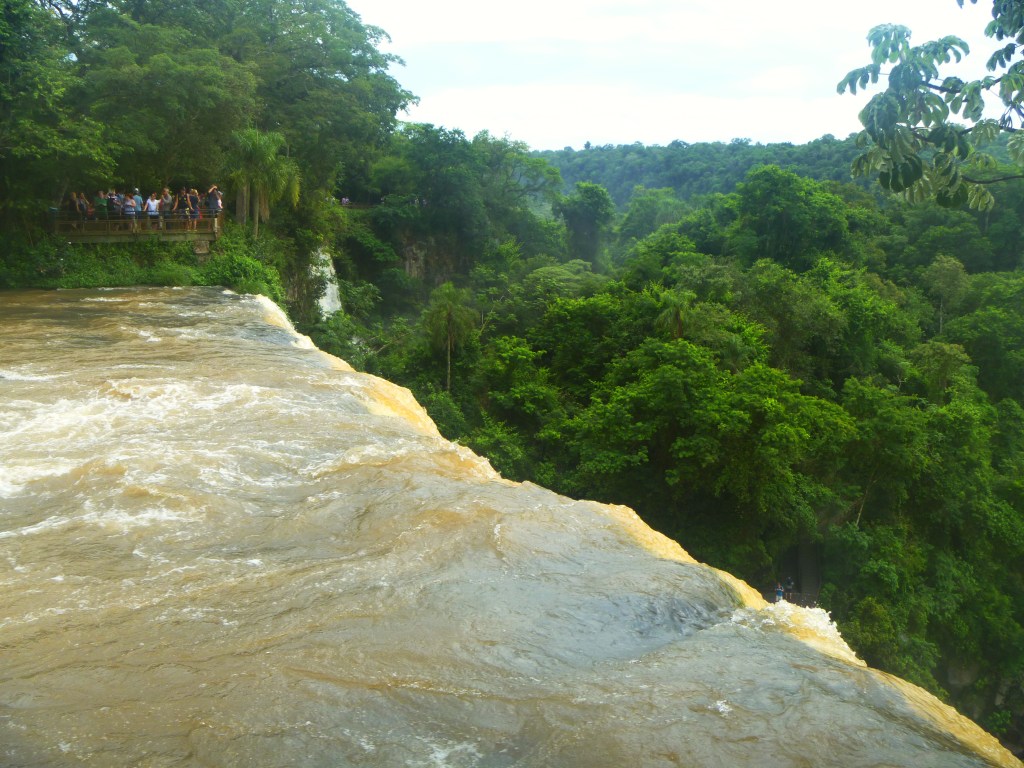
Once in the park, we followed a narrow boardwalk over several of the smaller falls toward the Devil’s Throat. A dim roar rumbled amidst the dense jungle, and the walkway quivered slightly beneath our feet. We carved a path to the fence separating the crowd from the rush of water that churned relentlessly toward its inevitable fall into vapor. After four months wandering through South America, it was easy to imagine we had reached a final nexus point with a future as unimaginable and unseen as whatever was beneath the mist that poured toward the sky from the depth of the canyon. The life we had left in Sacramento was upstream, my work in humanitarian aid and disaster response, his work in death care services, and our shared world of weekend camping trips to the hot springs and Redwood forest; whatever we would create from this point was as fresh and unknowable as the mouth of the Parana River that emptied downstream into the Atlantic Ocean, on the other side of this watery abyss. We shared a snack of roasted cashews and dried fruit, observing a space of silence to hear messages from the falls, and gazed at the edge of the world.
 Following the Nomad Star